
Issue: Week of October 25-31, 2026
Executive Summary
The Defense Intelligence Agency published the sharpest public photograph yet of China’s reusable spaceplane. A commercial imaging satellite took it in 2024. The frame shows a winged vehicle with the payload-bay doors open and solar arrays out. A classified craft in low Earth orbit can now be inspected by a camera that also sells pictures of parking lots. The flights are under Market & Geopolitical Trends.
On Thursday the Federal Communications Commission voted to ask whether nearly 500 megahertz more of licensed mobile spectrum should be opened to satellites that fill gaps in a carrier’s own network. Nothing was assigned, and the comment period has not started. The vote is under Space Policy & Regulation.
Market & Geopolitical Trends
The spaceplane, seen from another satellite
On Monday the Defense Intelligence Agency put a Maxar photograph in Challenges to Security in Space. Maxar now operates as Vantor. The picture is copyrighted 2024. The caption calls it a PRC spaceplane and names two programs, Shenlong and Tengyun, without saying which this is. Shenlong is the name Western reports use. Beijing calls the vehicle a reusable experimental spacecraft.
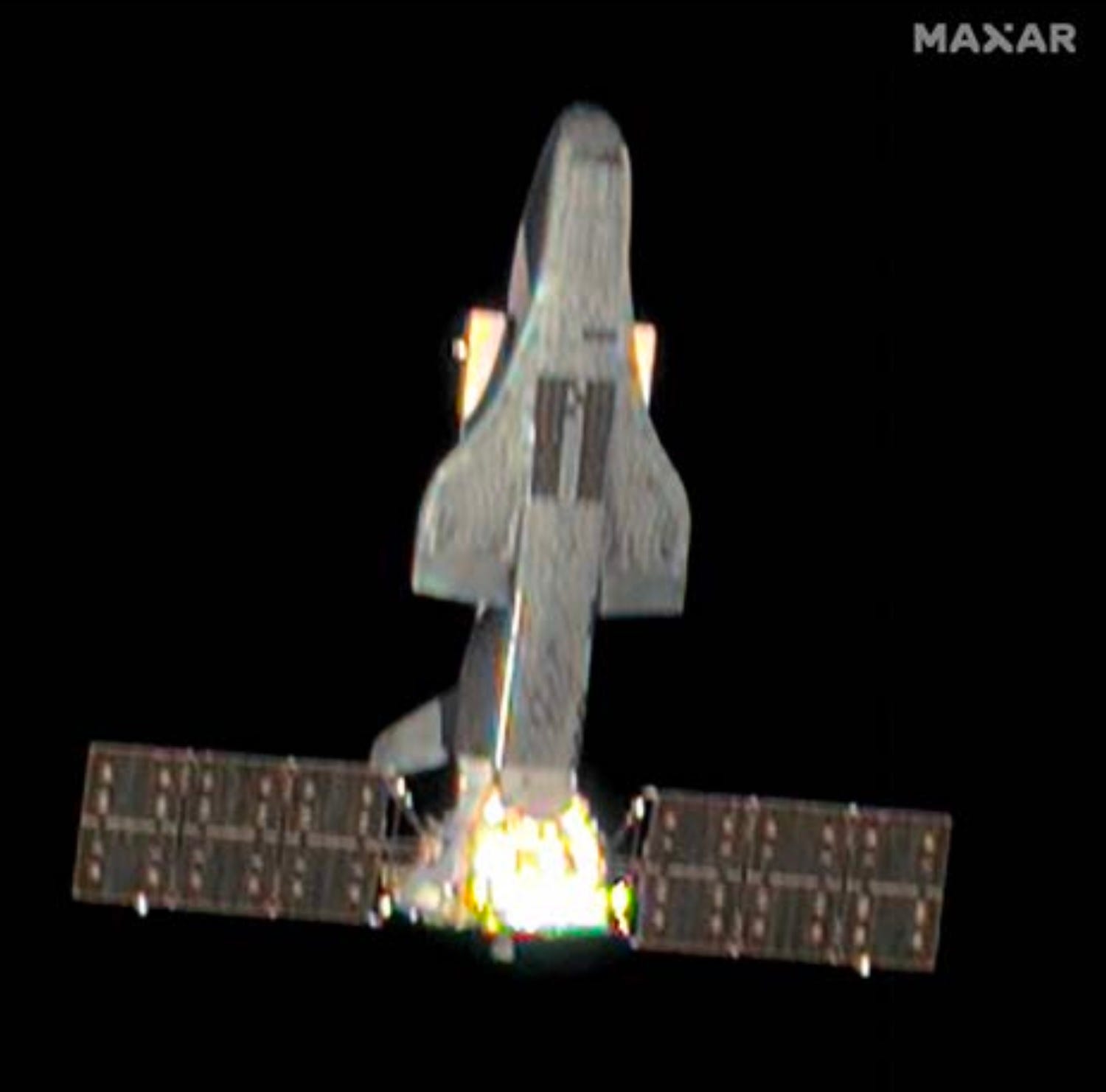
Payload-bay doors open, solar arrays out, sun glinting off the aft section. Maxar, 2024. Published by the Defense Intelligence Agency on October 26. Report: DIA.
It rides up inside a rocket fairing, works as a satellite, then glides to a runway. The layout sits close to the U.S. Space Force X-37B: delta wings, a central bay, a tail that carries the power. The agency does not claim China copied a drawing, and the picture shows no weapon. It shows that the bay can open.
China has flown it four times since 2020, on Long March 2F rockets from Jiuquan. The first lasted two days. The next two each stayed up about nine months. This frame is from the third. The fourth launched on February 7 and is still up. Ars Technica, citing Jonathan McDowell’s public catalog, says the vehicle now flying released a small satellite and took it back, twice, between June and September.
The same report says China has ground-based lasers that can disrupt satellites in low Earth orbit. The photograph is the part a reader can check. Non-Earth imaging, an Earth-observation camera turned on another spacecraft when two orbits cross, is now good enough to count doors.
Public Markets
Prices are the Friday close in US dollars for the week ending October 30, 2026. Week is that close versus the prior Friday close. YTD is the close versus the last close of the prior calendar year. Source: StockAnalysis for the SpaceX print, and the October 30 exchange closes for the rest of the list.
SpaceX (SPCX): $134.72, week -8.7%
Rocket Lab (RKLB): $54.73, week +4.0%, YTD -21.5%
AST SpaceMobile (ASTS): $40.97, week +3.0%, YTD -43.6%
Planet Labs (PL): $13.47, week +0.4%, YTD -31.7%
Intuitive Machines (LUNR): $10.67, week +1.4%, YTD -34.3%
Redwire (RDW): $8.39, week +0.4%, YTD +10.4%
Iridium (IRDM): $44.91, week +1.1%, YTD +161.7%
Procure Space ETF (UFO): $40.24, week +1.0%, YTD +4.1%
Four of the seven names beat UFO, which rose 1.0 percent. Rocket Lab led, up 4.0 percent, with no company announcement attached. SpaceX was last, down 8.7 percent, and closed under $140 for the first time since the October 22 unlock of about 1.3 billion shares. Iridium’s year-to-date figure is the June deal against the 2025 close. SpaceX has no 2025 close, so that line stops after the week.
Space Policy & Regulation
A proposal, not a license
On Thursday the Commission voted unanimously to open a rulemaking on direct-to-device service, a satellite talking to an ordinary phone. The notice, FCC-26-71, covers supplemental coverage from space: the satellite leases spectrum a mobile carrier already holds and fills holes in that network. Chairman Brendan Carr said it looks at nearly 500 megahertz and would take eligible bands from five to thirteen.
Nobody received spectrum on Thursday. SpaceX had asked to pull in the 902-928 megahertz band NextNav wants. Wireless Bureau chief Joel Taubenblatt said that request was left out. A final rule still has to clear comments and another vote. The comment clock starts when the notice reaches the Federal Register.
The same meeting advanced FCC-26-70, an auction of 25 megahertz, the 1675-1695 and 2020-2025 megahertz bands, for towers, satellites, or both. Carr expects heavy bidding because similar bands have sold for tens of billions on the secondary market. The federal study of whether 1675-1695 megahertz can leave government use is due in early 2027.
On October 27 the Space Bureau approved Amazon Leo’s bid for about 25 megahertz of Globalstar’s mobile-satellite spectrum, the satellite bands rather than a carrier’s. The purchase was reported at $11.5 billion. The satellites to use it are still ahead of Amazon.
Notable Products & Technologies
A clock, built in India
A navigation satellite stamps a time on a radio signal, and the receiver turns the delay into a distance. A billionth of a second is about a foot of error. ISRO says NVS-03 carries an atomic clock built in India, beside clocks bought abroad. The clock takes its beat from atoms, so it drifts far less than the oscillator in a phone.
It also adds an L1 signal to the L5 and S-band signals NavIC already sends. L1 is the band a civilian GPS chip already listens on. NavIC, Navigation with Indian Constellation, covers India and about 1,500 kilometers past the border. The first generation lost clocks in orbit and fell below the four satellites a basic fix needs. The new clock is aboard. The satellite is not yet on station. The launch is below.
New Patents
Nothing this week cleared the bar. On October 27 SpaceX received US 12,774,115, stacking satellites on one adaptor and letting the whole stack come free in orbit. Priority is May 2019. SpaceX has flown that dispenser for years.
Solved Problems & Industry Progress
The ground tests for Starship Flight 15 closed. On Sunday, October 25, Booster 22 fired all 33 Raptors in a static fire at Pad 2, Starbase, an engine run with the vehicle held down. Monday night Ship 42 lit one Raptor at Massey’s to imitate the deorbit burn. Tuesday it lit all six for about a minute. SpaceX said Wednesday both ship tests were done.
Flight 14 lost a vacuum-engine shutdown to a software glitch, and Ship 42 spent part of October with the engines out. They have fired again. Super Heavy has been caught three times. The ship never has. Musk put Flight 15 in November and said the plan is to catch both stages. The license is not issued. A missed catch can come down over the beach at Boca Chica. Space.com has the firing.
Capital & Investments
A loan for a pad that does not exist yet
On Monday the Pentagon’s Office of Strategic Capital signed a conditional commitment to lend Stoke Space $150 million. The announcement says the loan, next to private capital, would build a second pad at Stoke’s complex on Cape Canaveral Space Force Station. It is not closed. Stoke still has to pass financial, legal, and technical tests.
Space Launch Complex 14, the pad already there, is for Nova Pathfinder, aimed at early 2027. The new pad is for Nova Block 2, about 15 metric tons to low Earth orbit, aimed at 2029. Stoke has not reached orbit. September’s Series E put total capital raised near $2.3 billion. That equity is in the bank. This $150 million might be.
New Payloads & Launches
Four satellites, if this one climbs
GSLV-F18, the 20th flight of that rocket, left Sriharikota at 11:51 p.m. India time on Friday. About 18 minutes later it placed the 2,250-kilogram NVS-03 into a transfer orbit, a long ellipse the satellite still has to raise. Chairman V. Narayanan called the injection precise: 170.3 by 38,080 kilometers, against a target near 170.3 by 37,247. Solar arrays are out. The satellite’s own engine is supposed to finish the trip to 32.5 degrees east. The Hindu has his remarks.
He said NavIC is back at four satellites, the minimum for a basic fix. Seven make the full service. NVS-02 reached this same ellipse in January 2025 and stalled when a valve would not open, so “restored” is true only after this one fires and arrives. The countdown ran 24 hours. On the island, people stand outside for a night launch.
SatNet LEO Group 28, Long March 8A. Sunday, October 25, 10:03 a.m. Beijing time, Wenchang. Nine Guowang broadband satellites, by outside counts, which put the fleet near 231 against a filing for nearly 13,000. Xinhua said they reached orbit. The Philippine Space Agency had marked debris zones in its waters.
Starlink Group 15-16, Falcon 9. Tuesday, October 27, 12:25 a.m. Pacific, Vandenberg. Twenty-seven satellites to a 70-degree orbit. Booster B1082 landed on Of Course I Still Love You, its 26th flight. Vandenberg’s 72nd launch of the year, past the 2025 record. SpaceX warned three coastal counties about a sonic boom.
Starlink Group 15-18, Falcon 9. Friday, October 30, 9:04 p.m. Pacific, the same pad. Twenty-seven more. Booster B1093, 18th flight, same ship. Space.com counted the 118th Falcon 9 of 2026.
Looking Ahead
Monday, November 2: Electron from Mahia, The Sea God Surveys, a QPS-SAR radar satellite for iQPS. The date has already moved. The last note here put it no earlier than November 4.
November, no day set: Starship Flight 15 from Starbase. The static fires above are done. The license is not. The October 20 plan is to catch both stages.
Federal Register publication of Thursday’s two spectrum notices starts the comment clocks. No date yet.
If this week helped you read the market, forward it and subscribe.